
Policy Intelligence

Abby builds the policy. Your team proves it works.

Abby is the policy intelligence layer inside Povenos. She analyzes uploaded governance documents, identifies policy gaps, asks targeted questions to complete them, and generates enterprise-grade policy drafts mapped to your compliance frameworks.

The result is a structured policy your team can run as a simulation, not just a document to file.

AbbyPolicy Intelligence
Abby
I've analyzed your incident response policy document. Here's what I found:
What Abby found
Your policy covers escalation paths but doesn't specify acknowledgment timing
Communication requirements are defined for 3 stakeholder groups
Containment checkpoints are referenced but need measurable criteria
Abby
I noticed your policy doesn't define a maximum time for initial acknowledgment. Would you like me to add a 5-minute SLA for SEV-1 incidents?
Abby analyzes your existing documents and builds structured operational policies from them.

Capabilities

Six ways Abby works with your policies.
Analyze governance documents
Upload existing policies, runbooks, or compliance documents. Abby extracts requirements and flags what's missing.
Identify policy gaps
Abby compares your documents against framework requirements and surfaces gaps before they become audit findings.
Complete policies through questions
When information is missing, Abby asks targeted questions. The answers fill gaps automatically.
Generate enterprise policy drafts
Abby produces branded policy documents structured for your organization and ready for review.
Map to compliance frameworks
Every policy is mapped to NIST, SOC 2, HIPAA, HITRUST, ISO 27001, and ITIL.
Convert policy logic into simulation rules
Abby translates policy obligations into validation criteria for simulations.
Abby's policy intelligence interface in Policy Studio
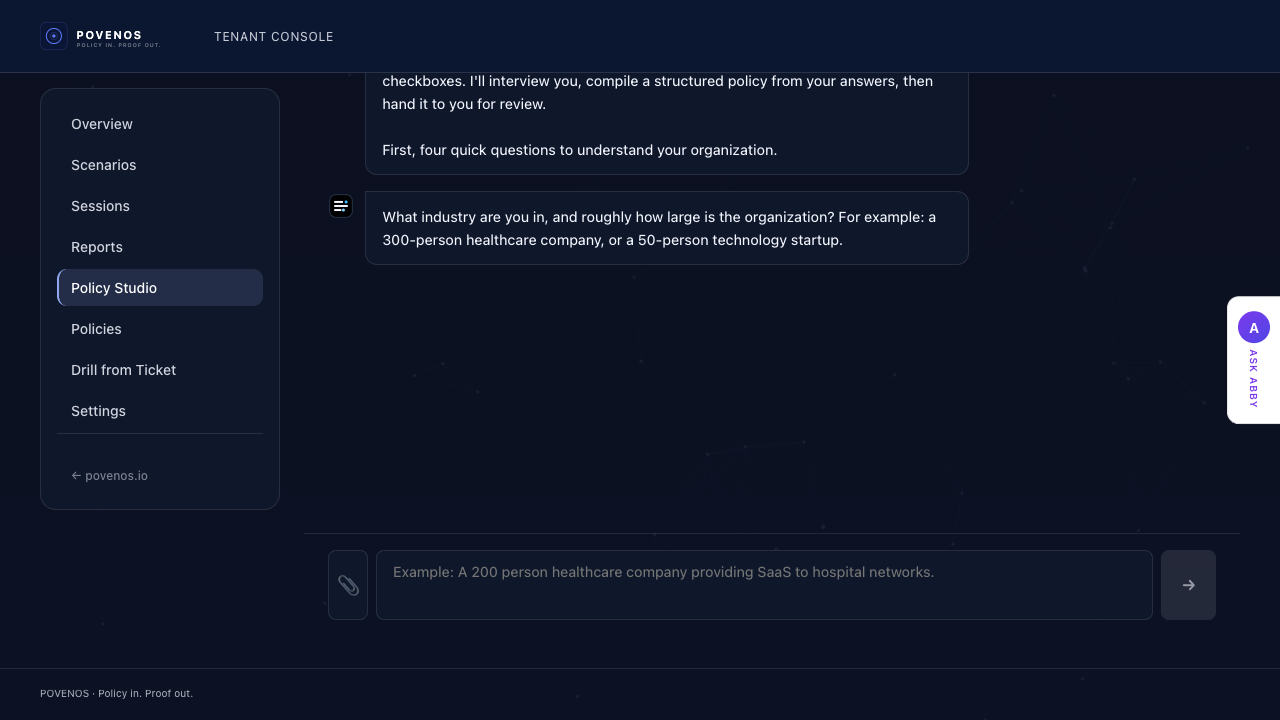
Abby works from uploaded documents or builds from scratch through a structured conversation.

In training runs.

During a simulation, Abby surfaces the relevant policy requirement at each decision point and explains what is at stake. She references the specific clause, the actor who owns the obligation, and the evidence required for the step to count as met.

OBLIGATIONS
Progress4 of 7
Acknowledge incident within 5 minutes
completed 2:14
Notify on-call engineering lead
completed 4:33
Post initial status update
completed 6:01
Begin root cause investigation
completed 8:15
Escalate if not contained within 15 minutes
in progress
Post containment verification
locked
Complete after-action report
not started
During training runs, Abby shows the relevant policy requirement at each decision point.

In live runs.

In live mode, Abby stays out of the way. She answers questions, surfaces the next required decision, and keeps the run moving without revealing scores or judgments.

The goal of a live run is an unbiased execution record. Abby facilitates without influencing.

POVENOSTRAININGRansomware Lateral MovementSEV 2
PHASE TRIAGEROLE Team Lead01:08:42
AlertsSignals
8
Credential reuse detected across admin endpoints
T+4minINVESTIGATED
File encryption detected on shared operations drive
T+6minACKNOWLEDGED
Immutable backup jobs lagging on restore window
T+8minNEW
Executive team requests recommendation on response posture
T+10minNEW
1 Decisions
2 Obligations
3 Evidence
4 Impact
5 Team
Decision Required180 SECONDS RESPONSE WINDOW

Confirm customer impact

Based on what the signal shows, what is the user-facing impact right now?

Policy
Confirm and record the user-facing impact before escalating to Major Incident status. Impact must be evidence-based, not assumed.
Confirm customer impact now — based on current signal
Proceeds on available data — scope may refine
Request additional diagnostics before confirming impact
+5 min delay — escalation window narrows
Escalate to Major Incident now — confirm impact after
Policy: impact confirmation required before escalation
Confidence Level
Low
Medium
High
Abby — Policy & Technical Advisor
Major Incident : Impact Classification (ITIL). Confirm and record the user-facing impact before escalating to Major Incident status.
DO
State impact in observable terms. Use the signal evidence — error rates, affected services, and timing — to describe what customers are actually experiencing.
AVOID
Without a confirmed impact statement, severity can't be set, leadership can't be briefed, and every downstream step stalls.
Abby
You are acting as TL. Use Abby for missing evidence, policy constraints, or the next check on Major Incident : Impact Classification (ITIL)
What should I do next?
Am I on track?
Who should I notify?
In live mode, Abby surfaces the next decision without revealing scores or judgments.

What Abby does not do.

Abby does not make decisions or override human judgment. If there is no clear policy guidance for a situation, she says so and flags it as a gap for the post-run review.

How Abby supports continuous improvement.

Each simulation run produces a record that links back to the policy Abby built. When a step was missed or delayed, the record shows which requirement was involved and who owned it.

Teams can see exactly which part of the policy needs to change and update it before the next run. When procedures change, Abby rebuilds the policy from the updated inputs.

Operational Readiness Dashboard
Aggregated across all active sessions
78%
Readiness Score
12
Sessions Completed
8
Active Participants
B+
Avg Grade
Session Score Trend
Session 1
62%
Session 2
68%
Session 3
71%
Session 4
78%
Session 5
78%
Each run links back to the policy. Over time you see which requirements hold and which need revision.

See how Policy Studio works

Export your policy at any stage.

Download an interview summary with every fact Abby extracted, or export the complete policy document with all clauses, obligations, timing requirements, and framework references.

Your policy is yours. Export it, share it with stakeholders, or use it as evidence for auditors.

Build your first policy with Abby.

Upload a document or start the interview. Most teams finish their first structured policy in under 30 minutes.