Policy Studio
Write the policy.
Run the policy.
Most policies are documents. Policy Studio turns procedures into executable, validated policies for ITIL, NIST, SOC 2, HIPAA, HITRUST, and ISO 27001.
Policy Domains
Build policies across incident response, change management, IAM, and more.
Policy Studio supports the operational procedures that compliance frameworks require but rarely validate. Build structured, testable policies for the domains that matter to your audit, your insurer, and your board.
Building scenarios from policy.
Every policy becomes a simulation scenario. The simulation tests whether your team can execute the policy under pressure, recording every decision and deviation.
Policies usually stop at documentation.
Companies write, store, and audit policies. Policy Studio turns them into structured policies that can be executed, not just filed away.
Step 1
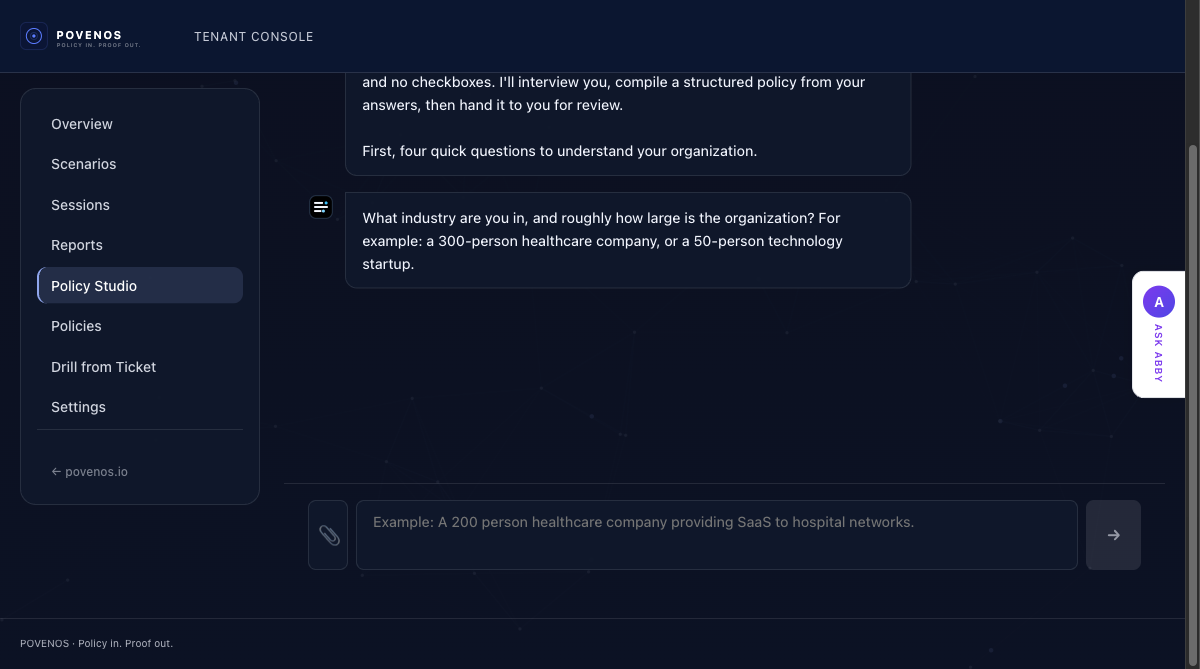
Tell Abby about your organization
Abby gathers context about your company, team, and systems to make the interview relevant to how you operate.
Step 2
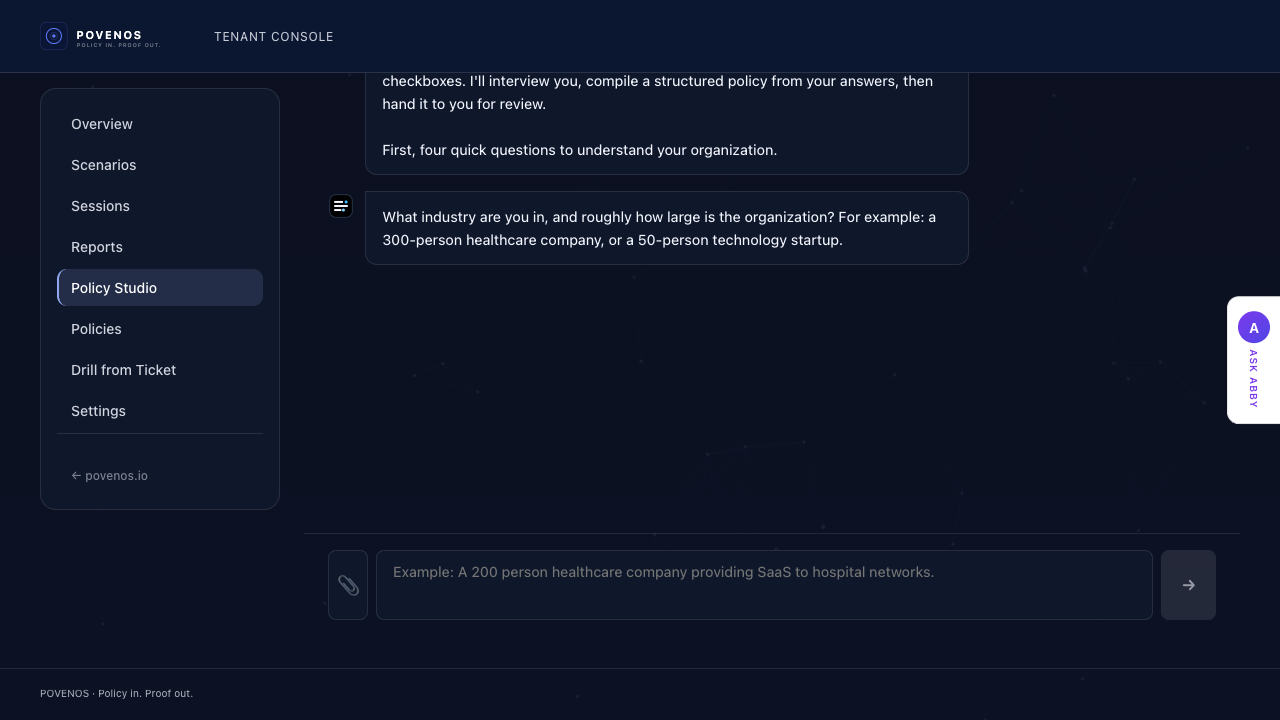
Build the policy through conversation
Describe the situation, responsibilities, and decisions in plain language. Abby structures it automatically.
Step 3
Abby structures it
Your answers are converted into a structured policy with triggers, roles, decisions, and actions, making it executable as a simulation.
Step 4
Review and finalize
Review the policy. Edit anything that needs adjustment. When finalized, the policy is locked and ready to run against scenarios.
Step 5
Run a simulation
Your policy runs as a scenario. Every decision, timing deviation, and missed step is recorded. You see where the policy held and where it failed.
Most platforms help you write policies. Povenos helps you prove they work.
Every policy becomes a testable scenario. Your team executes while the simulation records every decision, producing evidence for auditors.
Technology is changing faster than policies can keep up.
AI and new systems are evolving constantly. Policies written months ago may no longer reflect how systems operate. Policy Studio helps organizations keep policies aligned with reality: update, run, observe.
Cyber insurance is raising the bar.
Insurers now demand proof that procedures work, not just documentation. Simulations show detection speed, escalation effectiveness, and team coordination during disruptions.
Build a policy you can run.
Start the interview with Abby. Most people finish their first policy in under 30 minutes.